
What an Executive Assistant Really Costs In 2026
Salary is the number everyone compares. It is also the smallest part of the bill. Five ways to buy executive support, with the figures that never make it onto a pricing page.
 Atlas Assistants
Last updated: 29 October 2026
- The Five Ways to Buy This
- In-House: The Number Under the Number
- Freelance Marketplaces: Cheap Per Hour, Expensive Per Outcome
- Offshore Placement Agencies: The Fee You Pay Once and the Cost You Pay Monthly
- Managed Operator: What You Are Paying For
- The Fifth Option Nobody Prices: Your Own Time
- A Side-by-Side
- What Changes the Number Most
- Frequently Asked Questions
Key takeaways
- An in-house EA costs 1.4 to 1.6 times their salary once benefits, recruiting, management time and churn are counted.
- Hourly rates on freelance marketplaces look cheap and are expensive per outcome, because you are paying for your own time to brief, check and re-brief.
- The most expensive option on the list is the one nobody prices: continuing to do it yourself.
Every pricing conversation about executive support starts in the same place: "what does one cost?" It is the right question asked about the wrong number. Salary, or the monthly fee, is the figure that gets compared because it is the figure that is published. It is also, in almost every model, the smallest part of what you actually pay.
Here are the five ways to buy this, what each really costs once you count everything, and the one line item that never appears on anyone's pricing page.
The Five Ways to Buy This
- An in-house executive assistant. A US-based employee on your payroll.
- A freelance marketplace. Hourly virtual assistants through a platform.
- An offshore placement agency. A recruiter who finds you a remote hire for a fee, then steps away.
- A managed operator. A trained, employed professional, with the training, coaching, cover and management included. This is what Atlas does.
- Doing it yourself. The option everyone is already paying for.
The question is not what an assistant costs. It is what the next twelve months cost if nothing changes.
In-House: The Number Under the Number
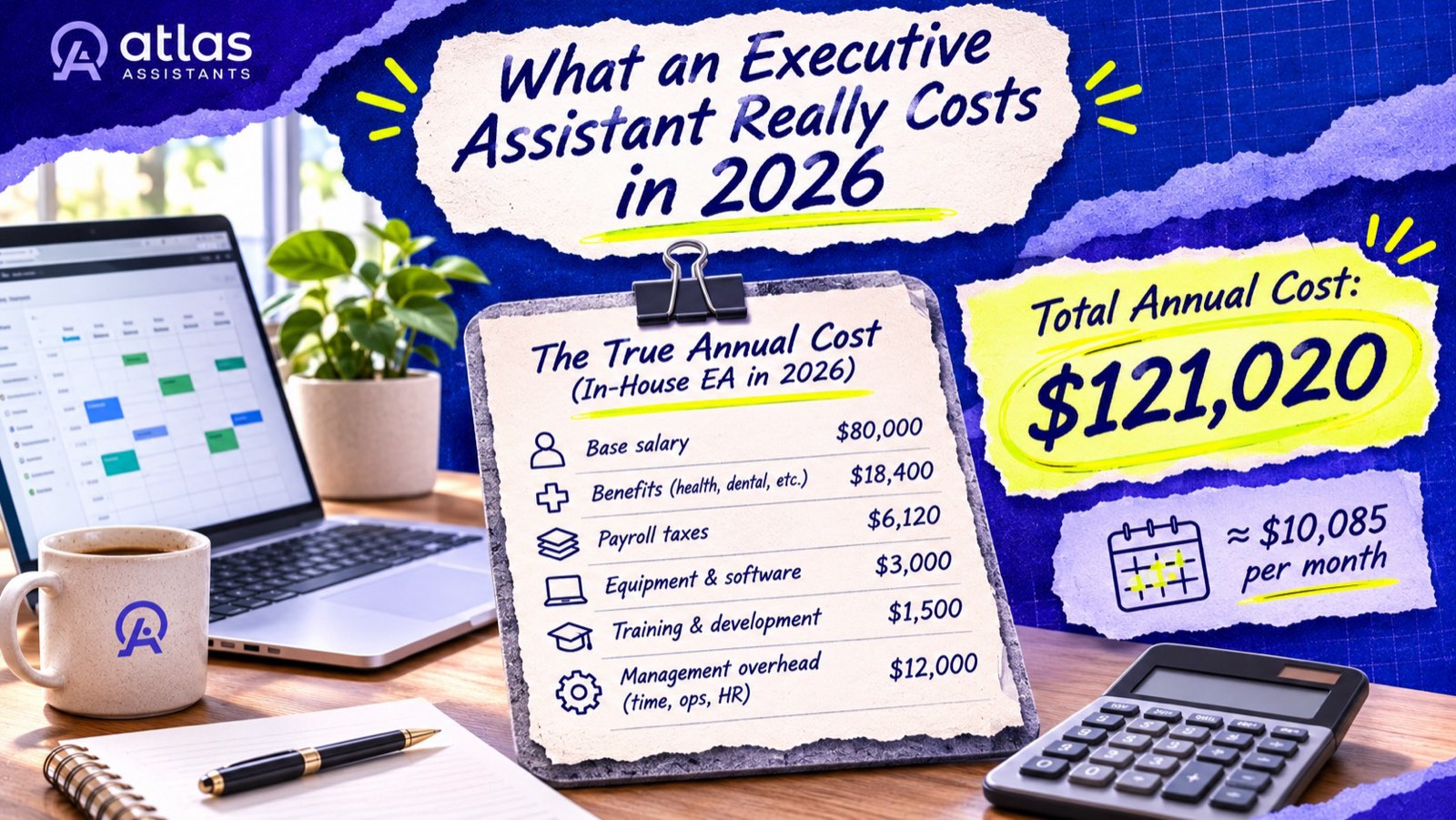
A US executive assistant supporting a founder or CEO earns somewhere between $70,000 and $95,000 depending on the city, with senior and chief-of-staff-adjacent roles well above that. That is the number people compare. Now add the rest.
- Employer costs. Payroll taxes, health insurance, retirement contributions, equipment and software. Typically 25 to 30 percent on top of salary.
- Recruiting. A recruiter fee of 20 to 25 percent of first-year salary, or six to ten weeks of your own time running the search.
- Time to productive. Two to three months before an in-house hire is running your systems rather than learning them, during which you are paying full salary and still doing most of the work.
- Management. This is the one nobody budgets. An assistant needs a manager, and in a founder-led business that manager is you. Weekly one-to-ones, feedback, training on new tools, coverage planning. Two to four hours a week of founder time, every week.
- Churn. Median tenure for executive assistants is short, and every departure restarts the clock on recruiting, ramp and training.
All in, an in-house EA costs 1.4 to 1.6 times their salary, before you count the hours of your own time spent managing them. For a $85,000 hire that is $120,000 to $135,000 a year, plus a slice of your week.
Freelance Marketplaces: Cheap Per Hour, Expensive Per Outcome
Hourly virtual assistants through a marketplace run anywhere from $8 to $35 an hour. On paper that is the cheapest line on this page. In practice it is often the most expensive, and the reason is where the work actually happens.
With an hourly freelancer, you are the system. You brief each task. You answer the questions. You check the output. You re-brief when it comes back wrong. You find a replacement when they take on a bigger client. None of that time is on the invoice, and all of it is yours.
The second cost is continuity. Nothing is written down unless you write it. When the freelancer changes, and they change often, the next one starts from zero. Every quarter is month one.
Freelance marketplaces are a good answer for a bounded project with a clear spec. They are a poor answer for the recurring work that runs your week, because recurring work needs an owner, and a freelancer is by definition not one.
Offshore Placement Agencies: The Fee You Pay Once and the Cost You Pay Monthly
Placement agencies find you a remote hire, usually in the Philippines, Latin America or South Africa, for a one-time fee or a monthly margin, and then step back. The salary is a fraction of a US hire and the candidate is often very good.
What you are not getting is everything around the person. There is no training before they start, so week one is a warm-up. There is no coaching after, so they are as good in month twelve as they were in month one. There is no cover when they are ill or on leave. There is no account manager, so when something is wrong you are the one who has to notice, diagnose and fix it. And if the fit is not right, you are back to the start, usually with another fee.
Placement works when you already have a manager, a documented process and a plan for cover. If you are a founder with none of those, you have bought a person and inherited a job.
Managed Operator: What You Are Paying For
This is the Atlas model, so here is exactly what the fee buys.
One full-time operator, dedicated to you, working your hours in your time zone. They were selected from over 2,000 applicants a week and went through training on inbox, calendar, travel, meeting systems, process writing and AI tools before they ever met you. Their pay is passed through to you at cost.
Around them: an account manager who owns the relationship and checks in monthly. Coaching every month so they get better at your business over time. Cover when they are away. A rematch with your context carried across if the fit ever changes. The Energy Audit before you start, and the Executive Atlas, the written manual of how you want things run, built as you go.
The number: $3,300 a month for the operator and everything around them, with a one-time $3,000 onboarding fee that covers the audit, your readiness coaching and the first match. Month to month, thirty days' notice.
What is not in it is your time as a manager. That is the point of the model, and it is the line that makes the comparison below look the way it does.
The Fifth Option Nobody Prices: Your Own Time
Here is the line item missing from every cost comparison, including most of ours until recently.
If you are not paying anyone to do this work, you are paying yourself to do it, at your rate, out of the hours that should be going to growth. The maths is not complicated.
Take what one hour of your time is worth. Most founders at this stage land between $250 and $500. Multiply by the hours a week going to work that does not need you; the Energy Audit usually finds 15 to 24. Multiply by 4.33 for a month.
At $250 an hour and 15 hours a week that is $16,238 a month. Against a $3,300 operator, that is a 4.9x return before the operator has automated anything. At $500 an hour it is more than $32,000 a month in founder time spent on an inbox.
You can argue with the hourly rate. You cannot argue with the hours, because the audit counts them.
The question is not what an assistant costs. It is what the next twelve months cost if nothing changes.
A Side-by-Side
| In-house EA | Freelance marketplace | Offshore placement | Managed operator (Atlas) | Yourself | |
|---|---|---|---|---|---|
| Visible monthly cost | $7,000 to $8,000 salary | $1,500 to $4,000 for 20 to 40 hrs | $1,200 to $2,500 salary plus fee | $3,300 | $0 |
| Hidden monthly cost | Benefits, recruiting, management | Your briefing and checking time | No training, no cover, no manager | None material | $16,000+ in founder hours |
| Trained before day one | No | No | Rarely | Yes, before day one | n/a |
| Coached after | Only if you do it | No | No | Monthly | n/a |
| Cover when away | You | You | You | Included | n/a |
| If it does not work | Restart, 3 to 4 months | Restart, days, from zero | Restart, often another fee | Rematch, context carried across | n/a |
| Written processes survive the person | Only if you wrote them | No | No | Yes, the Executive Atlas | No |
What Changes the Number Most
Three things move the real cost more than the headline rate.
Turnover. Every change of person restarts recruiting, ramp and training. The model with the lowest churn wins over a year even at a higher monthly rate. Under 2 percent of Atlas clients leave in a given month, and operators who move on are replaced from the same written manual.
Time to productive. Weeks of your time spent training someone are weeks you are paying twice. An operator who arrives already trained on the job and the tools closes that gap.
Whether anything is written down. If the process lives in a person, you pay to rebuild it every time the person changes. If it lives in a document, you pay once.
If you want the numbers for your own week rather than ours, the homepage calculator does the hourly maths, and the clarity call does the rest.
Frequently Asked Questions
Does Atlas Mark up the Operator'S Pay?
No. Your operator is employed and paid by Atlas, and their pay is passed through to you at cost. The monthly fee covers selection, training, coaching, the account manager, cover and rematching.
What Is in the Monthly Fee, Exactly?
One full-time operator in your hours, the twelve-week training they completed before placement, monthly coaching after it, your account manager, cover when they are away, and a rematch with your context carried across if the fit ever changes.
Are There Contracts?
Month to month, with thirty days' notice, and a Day-30 guarantee on our fee.
Do I Still Pay for AI Tools?
You pay for the tools your business already uses. Your operator works inside them. Most clients find they cancel a few subscriptions in the first quarter because the thing they were paying software to do badly is now done by a person properly.
Atlas places and trains executive operators, and coaches the founders who work with them. See what you are actually buying or book a call.
You Might Also Like

Doing It Yourself With AI vs Hiring an AI Operator
You have ChatGPT, a Claude project and a Grok bot. So why pay a person? An honest comparison, including the cases where you should not.

The Founder Bottleneck Is a Team-Size Problem
Nobody becomes the bottleneck on their own. It happens the quarter after you hire. Here is why it is structural, how to measure it in one question, and what to move first.

Why Your Last Assistant Did Not Work Out
It usually was not the person. Two failures account for almost everything we see, and only one of them is about who you hired.
You Can Make More Money.
You Cannot Make More Time
Two minutes to tell us where you are stuck. Then a conversation about whether this is the right moment for you.