
Blog / Masterclass · 5 min read
Cold Email That Builds Relationships and Revenue, With Shannon Beasley
Most cold email advice is outdated or reckless. Shannon Beasley of Acorn to Oak Strategies on the relationship-first framework, the only two metrics that matter, how to get past the EA filter, and exactly what to hand to your operator.
 Colin Pal
Recorded 17 March 2026 · Published 2 November 2026
- An Invitation, Not a Pitch
- The Only Two Metrics
- Sell the Outcome in Their Words
- The Framework
- The Founder Owns, the Operator Runs
- Deliverability: The Boring Part That Decides Everything
- Email as Level One, Ads as Level Two
- Where to Start
- Frequently Asked Questions
Key takeaways
- Cold email is an invitation, not a pitch. The only metrics worth tracking are reply rate and positive reply rate.
- The founder owns the ICP, the content strategy and the relationship. The operator owns the list, the setup, the monitoring and the inbox interpretation.
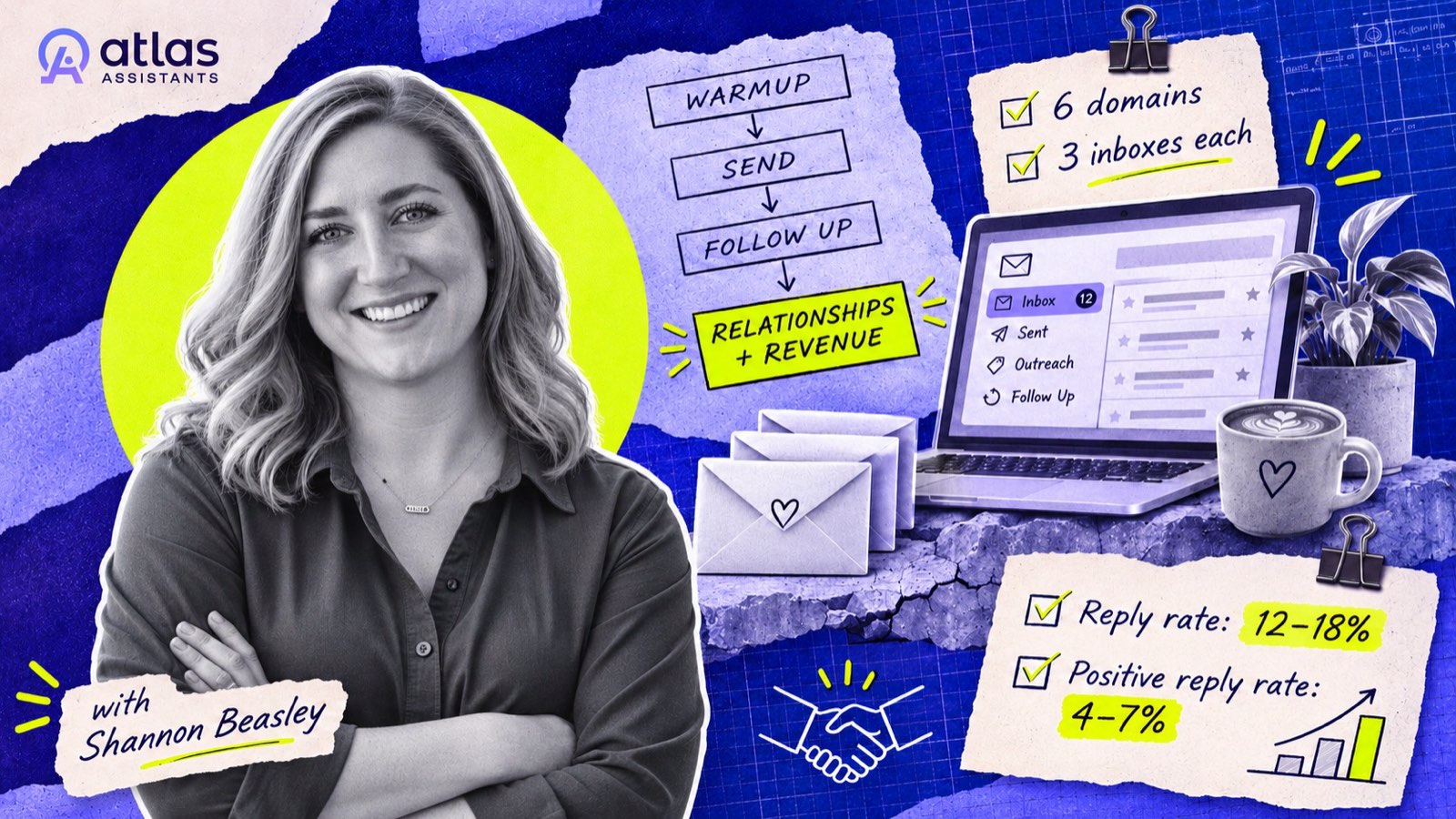
- Never send cold email from your main domain. Six domains, three inboxes each, warmed up, verified data, one variable changed at a time.
Colin's inbox, like most founders', is a wall of pitches, and he reads almost none of them. Thank God for the EA who filters it. So the question for this masterclass was practical: if you are going to use cold email, how do you do it so that it does not get filtered, does not damage your domain, and actually opens conversations with the people you want to work with?
Shannon Beasley has run outbound for service businesses for more than ten years at Acorn to Oak Strategies. Her answer starts with a reframe.

Watch on YouTube · More from the Atlas channel
An Invitation, Not a Pitch
Shannon's agency very rarely sends a direct pitch. Cold email, done her way, is a conversation starter and a permission-based door opener. The example she had received that morning: subject line "taxes?", a misspelled "here goes nothing", and a CPA's signature. That is how people end up in spam. The alternative is slower on paper and faster in practice, because the pitch-first version mostly gets ignored or flagged.
Why email at all, when ads and referrals exist? It is the lowest-cost, highest-control outbound channel, it compounds relationships over time, and it works before ads. Referrals are wonderful and unpredictable. Meta ads work and are expensive. Colin's own numbers back it up: around 55 percent of Atlas clients came from relationships, and the company turned off most paid ads last year to double down on what was working.
People buy outcomes. Nobody cares that your service is lead generation. They care about revenue predictability and getting out of the lead-gen seat.
The Only Two Metrics
Shannon does not monitor open rates. With AI tools and human EAs opening mail on an executive's behalf, opens are unreliable and say nothing about success. Click rates and inbox placement do not matter either if nobody replies. The two numbers that count are the reply rate and, above it, the positive reply rate. If those are healthy, everything upstream is working.
Sell the Outcome in Their Words
Founders describe the solution the way they understand it. Buyers experience the problem differently. A lead-gen agency says "we fix lead generation". The buyer feels revenue uncertainty, feast-or-famine cycles, no predictability. Writing to the second version is a small change with a large effect on positive replies.
Colin brings in the jobs-to-be-done lens from product: whatever someone hires you for, there is a functional job, an emotional job and a social job. Shannon pushes it to outcomes. Nobody buys AirPods for Bluetooth; they buy them because they just connect. Her emails drip outcomes, never features.
The Framework
- Hyper-specific ICP first. Without it you are guessing, and the reader can tell. Shannon uses Clay to enrich lists with buying signals: recent posts, expansions, acquisitions. That is the layer where AI earns its place, targeting rather than drafting.
- Context that proves you understand their world. Emailing finance leaders in the middle of tax season without acknowledging it is tone deaf. One line of awareness changes the response.
- Content that invites. Focus on the outcome they want and leave your service in the background.
- A low-friction invitation. A conversation for a white paper, a podcast invite, a topic worth their time. You learn their pain points; they get something useful; if a fit appears, that becomes a separate conversation. "Book a call now, don't miss out" has a place, and the first cold email is not it.
Response patterns differ by industry. Roofers and plumbers under $10 million are volume businesses and will not accept a podcast invite. Commercial construction leaders behind a desk will. Shannon starts campaigns with no fewer than 10,000 leads and lets the data decide.
The Founder Owns, the Operator Runs
This is the section Colin wanted most, because founders often ask for an EA and quietly expect a marketing department. Shannon's split:
- Founder owns: the ICP, the content strategy, and the relationship follow-through once a conversation opens.
- Operator owns: list building, domain and inbox setup, campaign monitoring, and the interpretation layer. If your EA is reading the inbox, their read on the language of replies is data; bring them into it.
Colin's method for the founder's part is Atlas's 10/80/10. The founder's first ten percent is vision, direction and a definition of done. The operator does the eighty: hand them the ICP worksheet and ask them to turn it into interview questions, extract the context from you on a call or a Loom, and draft the ICP and content strategy for review. The final ten percent is the founder refining it together with them. You never sit down with a blank worksheet.
Deliverability: The Boring Part That Decides Everything
If you take one thing from the session, Shannon says, take this: never send cold email from your main domain. Get flagged and you cannot send invoices, email clients or talk to your own team.
Her standards:
- Buy separate domains, $10 to $15 a year each. Minimum six, three inboxes per domain, eighteen sending inboxes, roughly 350 emails a day once warmed.
- Warm the domains before volume.
- Verify every address. A list from Apollo is a start; unverified addresses bounce and bounces get you flagged.
- Rotate sending inboxes (she uses Instantly) to protect deliverability.
- If a domain does get burned, fixing it is slow and technical; replace it and fix in parallel. In five years it has happened to her team a couple of times, because the stack is strict.
Email as Level One, Ads as Level Two
Cold email is also a brand-awareness layer. Shannon's data from retargeting people who had already seen her clients' emails: Meta click-through rates up two to four times, cost per click down 50 to 66 percent, conversion rates two to five times higher, and cost per acquisition down 70 to 90 percent on higher-ticket offers. Email builds the warm audience. Ads convert it. Recognition works below the conscious level; the ad looks familiar because the email came first.
Where to Start
Treat marketing as trial and fail, and fail fast. If reply rates are off, go back to the subject line first, then the body, and change one variable at a time or you will never know what moved. Shannon's rule for direct outreach is strict: clear case studies for the exact ICP and offer before any pitch-led campaign, because without them replies drop. If you want help deciding whether email is the right lever for you, that is a conversation your Atlas account manager can start.
Frequently Asked Questions
Is Cold Email Right for My Business?
Shannon's test: if you have a clear ICP, real case studies for that ICP, and a service that can be framed as an outcome in the buyer's words, it is the lowest-cost, highest-control outbound channel you have. If you lack any of those, start there.
Can My Atlas Operator Run This?
They can own the list building, domain and inbox setup, campaign monitoring and reply triage, and they can extract your ICP and content strategy from you with the 10/80/10 method. The ICP decisions and the relationship follow-through stay with you.
Why Not Just Use AI to Write the Emails?
Use it, but for enrichment and targeting rather than generic drafting. The messages that get replies show that you understand the buyer's world this month, and that comes from context, not from a prompt.
Atlas places and trains executive operators, and coaches the founders who work with them. See what you are actually buying or book a call.
You Might Also Like

What to Delegate First, and the Order That Actually Works
Everything feels too important, too hard to explain or too small to bother with, so nothing moves. Here is the sequence we use with every new client, and what the human actually does with each task once AI is in the room.
The Executive Support Checklist: Every Recurring Task Your Business Runs On
The fastest way to get your week back is not a better assistant. It is a complete list of the work that repeats, written so that someone else can own it. This is the list every Atlas operator is handed on day one.

What Atlas Operators Actually Do: Ten Real Weeks From Real Clients
Inbox and calendar are where it starts. Here is where it goes, told through the founders and operators it happened to.
You Can Make More Money.
You Cannot Make More Time
Two minutes to tell us where you are stuck. Then a conversation about whether this is the right moment for you.